Quick answer: The best drones for farming are not the same for every farm. Multirotor drones are practical for crop scouting, spraying, and close field checks, while fixed-wing drones are better for mapping large acreage. For U.S. farms, the right choice depends on the job, field size, payload, camera or sensor type, battery life, software, and FAA requirements.
Drones for farming are most useful when they match a real farm task: crop scouting, field mapping, spraying, irrigation checks, or livestock monitoring. A drone that works well for aerial photos may not be the best choice for crop spraying, and a small scouting drone may not cover large acreage efficiently.
This guide focuses on the best farming drones by practical use case, so U.S. farmers can compare drone types, sensors, payloads, flight time, software, and basic operating rules before buying or upgrading a farm drone.
What Are Drones for Farming?
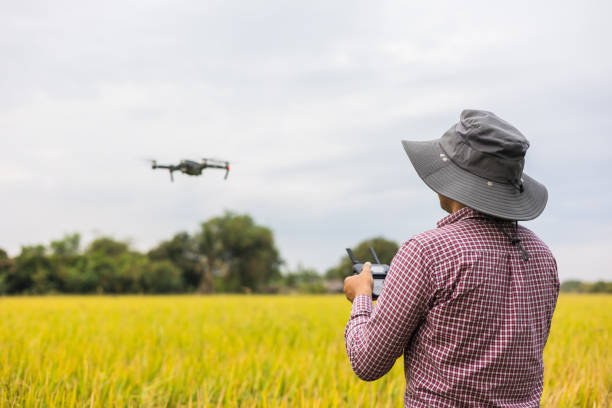
Agricultural drones, or agri-drones, are unmanned aerial vehicles (UAVs) designed specifically for farming tasks. They can perform a wide range of functions, from mapping fields and spraying crops to monitoring livestock and analyzing soil health. By automating labor-intensive tasks, these drones save time, reduce costs, and provide farmers with actionable insights to improve crop yields.
Drones for Farming vs. Agricultural Drones: Is There a Difference?
Drones for farming and agricultural drones usually describe the same category of farm UAVs, but searchers often use the terms differently. “Drones for farming” usually means practical tools a farmer can use for crop scouting, spraying, mapping, irrigation checks, and field monitoring.
“Agricultural drones” is a broader term that may include research drones, advanced precision agriculture systems, multispectral sensors, and commercial aerial application platforms. In this article, the focus is narrower: choosing the best drone for real farm tasks, not repeating a general explanation of agricultural drone technology.
Best Farming Drone by Task: Quick Guide
The best farming drone depends on the job. For crop scouting, a compact multirotor drone with a good RGB camera is usually the easiest starting point. For field mapping, a fixed-wing drone or an RTK-capable drone is better because it can cover more ground and produce more accurate maps.
For spraying, farmers need a drone designed for payload capacity, stable low-altitude flight, tank size, nozzle control, and safe chemical handling. For crop health analysis, a drone with multispectral or thermal sensors is more useful than a basic camera drone because it can help identify plant stress, irrigation issues, or weak field zones earlier.
- Best for beginners: a small multirotor drone for crop scouting and field images.
- Best for large fields: a fixed-wing or long-endurance mapping drone.
- Best for spraying: a dedicated agricultural spraying drone with payload and nozzle control.
- Best for crop health: a drone with multispectral or thermal imaging.
- Best for precision maps: an RTK drone with reliable mapping software.
Top 5 Best Drones for Farming by Task
Here are the top 5 drones that are making waves in agriculture this year:
- DJI Agras MG-1
- Flight Time: 24 minutes
- Flight Range: 1 km
- Weight: 8.8 kg
- Best For: Crop spraying and precision agriculture.
- Parrot Bluegrass
- Flight Time: 25 minutes
- Flight Range: 2 km
- Weight: 1.85 kg
- Best For: Field mapping and crop monitoring.
- DJI Phantom 4 RTK
- Flight Time: 30 minutes
- Flight Range: 7 km
- Weight: 1.39 kg
- Best For: High-precision mapping and surveying.
- DJI Mavic 2 Pro
- Flight Time: 31 minutes
- Flight Range: 10 km
- Weight: 907 g
- Best For: Aerial imaging and crop health analysis.
- DJI Matrice 300 RTK
- Flight Time: 55 minutes
- Flight Range: 15 km
- Weight: 3.6 kg
- Best For: Advanced agricultural applications and large-scale farming.
Best Farming Drones for Beginners
For beginners, the most practical farming drone is usually a simple multirotor drone with stable flight, a clear camera, good battery life, and easy mapping or photo-export features. A beginner does not always need the most expensive spraying drone or advanced multispectral system on the first purchase.
The best starting point is to choose one farm task first. If the goal is checking crop stands, weed pressure, irrigation problems, or storm damage, a camera drone may be enough. If the goal is applying pesticides or fertilizers, the farmer should look at dedicated spraying drones and review U.S. aviation and pesticide rules before operating commercially.
Best Drone Type for Farming: Spraying, Mapping, or Scouting?
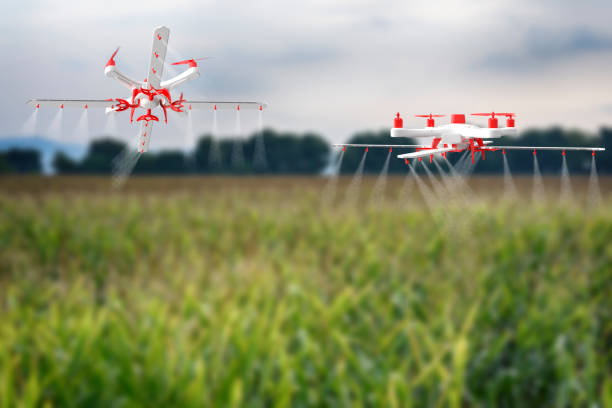
There are two main types of agricultural drones: fixed-wing drones and multi-rotor drones.
- Fixed-wing drones are ideal for large-scale farms, as they can cover vast areas quickly and stay airborne for extended periods. They’re perfect for mapping and monitoring expansive fields.
- Multi-rotor drones, on the other hand, are highly maneuverable and excel at precision tasks like crop spraying and soil analysis.
Some advanced drones are equipped with infrared or multispectral cameras, enabling farmers to detect crop diseases and nutrient deficiencies before they become visible to the naked eye.
How Farming Drones Help with Mapping, Spraying, and Crop Scouting
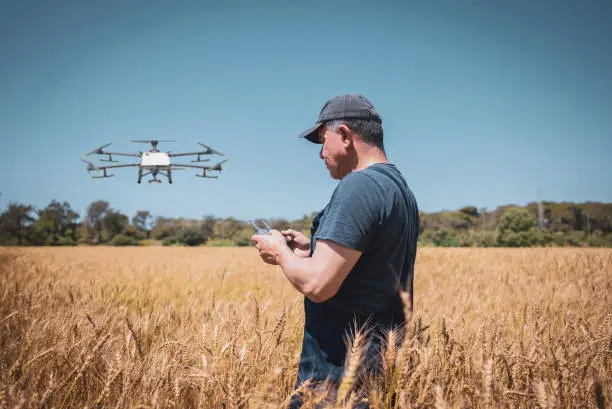
Agricultural drones are built with advanced technology to withstand harsh weather conditions and challenging terrains. Equipped with GPS systems, they can perform automated flights with pinpoint accuracy, collecting real-time data for farmers.
The operation process involves three key steps:
- Pre-flight checks to ensure the drone is in optimal condition.
- Mission planning, where flight parameters like altitude and speed are set.
- Post-flight analysis, where farmers use the collected data to make informed decisions about their crops.
What Should Farmers Check Before Buying a Drone?
While drones offer immense potential, there are challenges to consider, such as high initial costs, regulatory restrictions, and limited battery life. However, advancements in AI and battery technology are paving the way for even more innovative applications.
In the future, drones could integrate predictive analytics to forecast crop diseases or optimize harvest times. They may also become more accessible to small-scale farmers, democratizing precision agriculture and contributing to global food security.
Do Farmers Need a Drone License in the U.S.?
Before using agricultural drones, farmers must comply with local regulations. In the U.S., the Federal Aviation Administration (FAA) governs drone usage under Part 107 rules, which require operators to obtain a Remote Pilot Certificate. Privacy concerns also arise, as drones may capture images of neighboring properties. Farmers should stay informed about both federal and state laws to ensure compliance.
Why Do Farmers Use Drones?
Agricultural drones are transforming farming in numerous ways:
- Improved Crop Monitoring: Drones provide high-resolution aerial images, helping farmers detect issues like pest infestations or irrigation problems early.
- Efficient Resource Management: By identifying areas that need water or fertilizer, drones help reduce waste and optimize resource use.
- Cost Savings: Drones reduce the need for manual labor and minimize the overuse of chemicals, saving farmers time and money.
- Increased Yields: With precise data, farmers can make better decisions, leading to healthier crops and higher productivity.
Which Farming Drone Should You Choose
Drones are being used in a variety of farming tasks:
- Crop Monitoring: Drones equipped with advanced sensors can detect crop health issues early, allowing farmers to take proactive measures.
- Soil Analysis: Drones create detailed 3D maps of fields, helping farmers plan planting patterns and predict yields.
- Irrigation Management: Thermal sensors identify dry areas, enabling precise water usage and reducing waste.
- Livestock Monitoring: Drones track livestock movements and detect signs of disease, improving herd management.
Conclusion
Agricultural drones are no longer a futuristic concept—they’re here, and they’re transforming farming as we know it. From improving crop yields to reducing labor costs, these high-tech tools are empowering farmers to work smarter, not harder.
If you’re ready to take your farming operations to the next level, consider investing in one of the top 5 drones listed above. With their advanced features and proven results, they’re the ultimate tools for modern agriculture.
Sources & References
- FAA — Certificated Remote Pilots including Commercial Operators
- FAA — Dispensing Chemicals and Agricultural Products with UAS
- University of Florida IFAS — Regulatory Requirements to Operate Spraying Drones
- FAA — Remote ID for Drones
- eCFR — 14 CFR Part 107 Small Unmanned Aircraft Systems
- eCFR — 14 CFR Part 137 Agricultural Aircraft Operations