
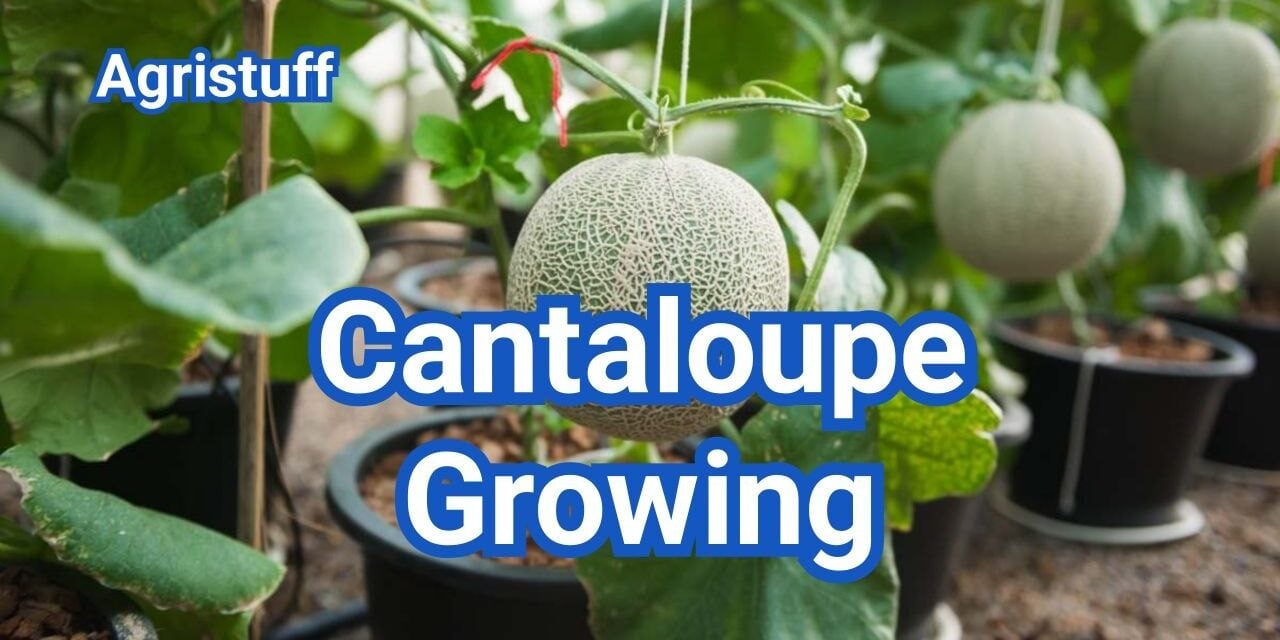
The term cantaloupe growing means cultivating cantaloupe plants from seed or transplants through flowering, fruit development, and harvest. In the United States, “cantaloupe” usually refers to netted, musk-scented muskmelons belonging to Cucumis melo, commonly with orange flesh. These warm-season vines belong to the cucumber family, Cucurbitaceae. Clemson Extension: cantaloupe and honeydew melons.
Quick answer: For reliable cantaloupe growing, plant after frost danger has passed and soil has warmed to at least 65°F, preferably around 70°F for direct sowing. Provide full sun, well-drained soil, steady moisture during fruit development, and access for pollinating insects. Harvest traditional slip-type varieties when the mature fruit separates easily from its stem, using the variety’s other ripeness indicators as confirmation. Utah State University Extension: cantaloupe in the garden.
On a warm summer day, cutting into a fragrant cantaloupe from your garden can make the season feel especially rewarding. Cantaloupe is a warm-season crop, meaning a plant that grows best in warm weather and does not tolerate frost. Success comes from matching the fruit to your garden’s conditions and giving it steady care.
You’ll learn how to choose a suitable location, prepare the soil, select a variety, and plant seeds or seedlings. You’ll also find practical ways to tend the vines, protect their leaves, and judge when fruit is ripe. The goal is a healthy crop, not a perfect-looking garden. Once the growing season and site suit the plant, the rest becomes a series of manageable choices.
Key Takeaways
- Choose a sunny site with a long, frost-free stretch of warm weather.
- Prepare soil that drains well and supports healthy roots.
- Match variety maturity and vine habit to your season and space.
- Keep moisture steady, protect healthy leaves, and leave flowers accessible to pollinators.
- Use several signs together to decide when the fruit has reached a natural slip.
Good results start by matching the growing season and garden site to the crop. Begin by checking whether your location offers the warmth, sunlight, and open space the vines need.
Where Can Cantaloupe Grow Successfully?
Cantaloupe grows best in a warm, sunny site with a long enough frost-free season for fruit to mature. Choose a level, open garden location near water, with full sun and warm soil.
Give plants 6-8 hours of sun each day, and wait until the soil reaches at least 70°F (21°C) for good establishment. Cantaloupe is frost-tender, so frost can damage or kill plants. A stretch of hot weather, often about 90 days or more, helps the melons mature.
Plant only after frost danger has passed and soil is at least 70°F (21°C). A long stretch of hot weather gives fruit time to mature.
Give the vines a sunny, open site
Pick a spot where vines can spread without being crowded by shrubs, trees, or other plants. Avoid shade, lawn sprinklers, persistent weeds, and beds with a history of disease trouble. Nearby water makes it easier to respond when the soil begins to dry.
A cantaloupe growing zone can help you compare broad climate patterns, but it cannot tell you when your local frost danger ends. Your local frost timing, summer heat, and length of the cantaloupe growing season matter more. A garden in a cooler zone may still support a crop when its warm season is long enough.
Match planting to your frost-free window
Use your area’s last spring frost date and actual soil warmth, rather than relying on a fixed national planting month. The plants need warm conditions after planting, not just a warm afternoon. A long period of hot weather gives the fruit more time to mature before cold returns.
Look for a level, well-exposed bed that is easy to water and unlikely to collect runoff. When the location has the right light and season, the next step is preparing soil that drains freely and supports vigorous growth.
How to Prepare Soil for Cantaloupe Growing

Squeeze a handful of garden soil to get a quick sense of its texture and moisture. Soil that crumbles more readily is a better sign than a wet handful that holds together in a dense clump.
Aim for well-drained sandy loam or silt loam with a pH of 6.0-6.5. Roots need air as well as water, and saturated soil can limit both. Soil that drains too quickly may leave roots short of moisture, so adding organic matter can help improve its structure.
Check texture, drainage, and acidity
A simple squeeze test is a starting point, not a substitute for a pH test. If your soil forms a sticky ball while wet, it may be clay-heavy. If it falls through your fingers almost at once, it may be sandy and quick to dry.
Drainage matters because roots need oxygen to function. A bed that stays soggy after rain can stress plants and make root problems more likely. Use a soil test to check acidity and nutrient levels before you decide whether anything besides compost is needed.
Improve the bed before planting
Compost or well-rotted manure can improve clay soil’s structure and help sandy soil hold moisture. Work amendments into moist soil before planting, but avoid working it when it is thoroughly wet. That can compact the bed and damage its structure.
Remove weeds and old crop debris before adding amendments. Weeds compete for water and nutrients, while plant debris can carry problems into a new crop. Make these four checks before planting:
- Test the soil’s moisture and texture with a handful.
- Clear weeds and old crop debris from the bed.
- Loosen the soil and incorporate compost or aged manure.
- Water, let weed seedlings emerge, then remove them before planting.
Once the bed is prepared, choose a variety that fits both the available season and the space where its vines will grow.
Which Cantaloupe Varieties Fit Your Garden?
Choose a variety that can mature within your local warm season and fits the space you have. Days to maturity help with planning, while fruit size and vine habit help you picture the harvest and the room plants will need.
Use maturity estimates as a guide, not a promise: weather and growing conditions can shift the time to harvest. A compact growth habit can save space, but it does not remove the need for sun, warmth, and suitable soil.
Choose by maturity time and available space
Compare the seed packet’s maturity estimate with the length of your local growing season. Also consider whether you want smaller fruit for one or two people, or larger melons to share. Vines that spread widely need more room, even when their fruit is modest in size.
Compare five familiar varieties
These familiar varieties offer different combinations of flavor, maturity, fruit size, and vine habit. Approximate days begin at planting and can vary with conditions. Check the packet for the exact variety you plan to grow, since the listed traits help you compare but do not guarantee the same result in every garden.
| Variety | Approximate days to maturity | Reported fruit size or trait | Useful garden fit |
|---|---|---|---|
| ‘Ambrosia’ | About 85 days | Known for sweet fruit | For gardeners prioritizing sweetness |
| ‘Athena’ | 70-80 days | 5-6-pound fruit | For gardeners wanting larger melons |
| ‘Hale’s Best Jumbo’ | 80-90 days | Aromatic fruit, about 3 pounds | For gardeners who value aroma |
| ‘Minnesota Midget’ | 70-80 days | Sweet fruit, about 1 pound | For smaller fruit and limited space |
| ‘Bush Star’ | About 90 days | Bush growth habit | For a more compact vine habit |
When space is tight, a bush type may be easier to manage than a sprawling vine. Still, compact plants need room belowground for roots and enough light to grow and set fruit. Choose the best fit, then decide whether direct sowing or indoor seed-starting suits your climate.
How to Start Cantaloupe From Seed

You can sow seeds outdoors when the bed is warm, or start them indoors to gain time in a short season. Direct sowing avoids transplant shock when warm conditions arrive early and the soil is ready.
Sow seeds about 1 inch deep; in cooler regions, start indoors 4-6 weeks before the last spring frost. A seed-starting setup helps seedlings grow before outdoor planting, but it cannot make cold garden soil suitable.
Direct-sow when the bed is warm
Direct-sown seeds establish in place, so their roots do not need to adjust after transplanting. This method works well when frost danger has passed and the bed is warm enough. If spring stays cool, seeds may take longer to emerge, so do not treat an early sowing date as a shortcut around cold soil.
Start seedlings indoors in cooler regions
Indoor seed-starting can give a short-season garden a head start. Use peat pots or soil blocks to limit root disturbance, since cantaloupe roots do not benefit from rough handling. Harden seedlings off gradually before moving them outside, so they can adjust to outdoor conditions.
Transplant 2-3 weeks after the last spring frost, once soil is at least 70°F (21°C). Seedlings should be handled gently and kept from becoming root-bound. A warm room alone does not replace the warmth needed in the garden bed.
| Method | When to begin | Main advantage | Main caution |
|---|---|---|---|
| Direct sowing outdoors | After frost danger, in warm soil | No transplant shock | Seeds wait if soil is cold |
| Indoor seed-starting | 4-6 weeks before last spring frost | Head start in a short season | Roots need gentle handling |
| Nursery transplant | 2-3 weeks after last spring frost | Ready-grown seedling | Harden off before planting |
Whichever method you choose, planting success depends on setting the seed or young plant at the right spacing and handling its roots with care.
When and How Should You Plant Cantaloupe?

If your bed is ready but the last frost risk has not passed, wait before planting. Warm soil and frost-free weather matter more than a convenient date on the calendar.
Plant only after frost danger has passed and the soil is warm; space plants about 18-36 inches apart. Rows are generally 3-6 feet apart, depending on variety and layout. Some sprawling varieties need 36-42 inches between plants.
Set spacing for sprawling vines
Check the seed packet first, since its spacing takes priority when it gives variety-specific directions. Leave room for vines to spread and for you to reach plants when watering. Tight spacing can make access harder and leave foliage crowded.
Direct-sown seeds and transplants need the same warm, frost-free conditions. Seedlings should have 4-6 true leaves before transplanting, and they should be hardened off first. Keep their roots intact when moving them into the bed.
Transplant without checking growth
Do not plant a young seedling simply because it is available. Check for true leaves and warm soil, then handle the root ball gently. Burying stems unusually deep is not required; set the plant at a sensible depth and firm soil around its roots.
Follow this sequence for seeds or transplants:
- Check the forecast and make sure the soil is warm.
- Mark rows and plant spacing using the packet’s directions.
- Sow seed about 1 inch deep or prepare a transplant hole.
- Firm soil gently around the seed or plant.
- Water to settle the soil around the roots.
If your garden has little open ground, a container may offer a workable home for one compact plant.
Can You Grow Cantaloupe in Pots?
Yes, cantaloupe can grow in a pot if the container is large, well-drained, and in full sun. Use fertile potting mix and a stable container with drainage holes.
Containers dry faster than garden beds, so check moisture more often and water when the mix begins to dry. A compact variety is easier to manage, but it still needs enough root space and room for developing fruit.
Choose a large, stable container
Choose a container that will not tip easily as vines spread or fruit grows. Drainage holes let extra water escape, while fertile potting mix gives roots room to grow. Set the pot in a warm, sunny position and avoid letting its base sit in standing water.
Manage water, nutrients, and vine growth
Potting mix can dry faster than soil in a garden bed, especially in warm or windy weather. Check the mix rather than following a fixed watering schedule. Consistent moisture supports growth, while waterlogged mix can deprive roots of air.
Vines can spread over the pot’s edge or climb a support if you provide one. If a vine grows upward, support heavy fruit in a sling so it does not pull free as it develops. A smaller plant may save ground space, but it still needs sunlight, water, and care.
Container growing changes where the vines spread, not whether they need room. Decide next whether to let them sprawl across the ground or guide them up a sturdy support.
Should Cantaloupe Vines Grow on the Ground or a Trellis?
Both ground growing and trellising work; choose based on available space and whether you can support developing fruit. Cantaloupe does not have to climb, and ground-grown vines are a simple choice when room is available.
A trellis can improve airflow and access, but it must be firmly anchored and strong enough to hold vines and supported fruit. Ground-grown fruit should not sit directly on wet soil.
Let vines spread across the ground
Ground-sprawling vines need open space and can be easy to manage in a roomy bed. Keep developing fruit off bare or wet soil with mulch, an upturned can, or a flower pot. This small barrier helps protect the rind from direct contact with damp ground.
Train vines up a sturdy support
A trellis makes use of vertical space and can improve airflow around leaves. In warm climates, a trellis can be as large as 8 feet tall and 20 feet wide. Anchor it firmly before vines become heavy, then secure them with soft ties rather than tight wire.
Melons growing above ground need slings or another reliable support. Check that each sling holds the fruit without cutting into the vine. Trellising can make leaves and fruit easier to reach, but it adds work and requires a sturdy structure.
| Growing method | Space use | Airflow and access | Fruit support |
|---|---|---|---|
| Ground-sprawling vines | More horizontal room | Access depends on vine spread | Mulch, upturned can, or flower pot |
| Trellised vines | Uses vertical space | Better airflow and access | Strong trellis and fruit slings |
| Vines trained in a small garden | Needs a compact footprint | Good access with regular tying | Anchored support and slings |
For a small garden, train vines along a strong support and guide them as they grow. Whether vines spread or climb, both arrangements depend on steady moisture for healthy growth and fruit development.
How Often Should You Water Cantaloupe?

A general starting point during vine growth, flowering, and fruit set is about 2 inches of water per week, including rainfall. Water needs shift with heat, soil, and the size of the plant.
Keep moisture steady during fruit set: drought stress and excessive water can both harm fruit. Sandy beds and containers may dry faster, so check them more often than heavier garden soil.
Keep moisture steady as vines grow and set fruit
Count rainfall toward the weekly total rather than adding the full amount on top of rain. Check the soil before irrigating, since a hot week may dry a bed faster than cool weather. Drip irrigation or a soaker hose can deliver water near the roots.
Protect leaves and fruit from excess water
Water at the soil level where possible, keeping foliage dry and reducing the chance of disease. If you must use overhead watering, do it in the morning so leaves have time to dry. Avoid letting the soil remain soggy, since roots need air.
As fruit approaches ripeness, you can reduce irrigation modestly. Do not let the vines remain wilted, though, since ongoing water stress can weaken the plant. Use this four-part check before watering:
- Feel the soil near the roots for moisture.
- Check recent rainfall before adding more water.
- Water at the base with drip irrigation or a soaker hose.
- Look for persistent evening wilt or soggy soil.
A layer of mulch can help stabilize moisture between checks and suppress weeds that compete with the vines.
How Do Cantaloupe Flowers Become Fruit?

The first flowers on cantaloupe plants may be male, and male flowers alone do not form fruit. Female flowers have a small swelling at the base that can develop into a melon after pollination.
Bees carry pollen between male and female flowers, so leave flowers open to visiting pollinators. Both flower types grow on the same plant, though female flowers may appear about a week after the first male blooms.
Identify male and female blossoms
Look closely at the base of each flower. A female flower has a small swelling there, while a male flower does not. That swelling is the part that can grow into fruit after pollen reaches the flower.
Early male flowers are a normal part of the plant’s flowering sequence. They provide pollen, but they cannot become melons by themselves. Seeing blooms without fruit right away does not mean the plant has failed.
Leave pollinators access to the flowers
Bees need access to both flower types to carry pollen from one bloom to another. Remove floating row covers once flowers appear, so pollinators can reach them. Avoid blocking blooms during the time when flowers are open.
If bees are not visiting and you can identify the flower types, hand-pollination is an option. A small brush can transfer pollen from a male bloom to a female one. Once flowers have set fruit, attention shifts to plant nutrition and the healthy leaves that support development.
How Should You Feed and Prune Cantaloupe?

The goal is steady growth, not the largest possible mass of leaves. Cantaloupes are heavy feeders, but excess nitrogen can push leafy growth at the expense of fruit.
Healthy leaves make sugars that contribute to fruit sweetness, so do not remove them just to try to sweeten melons. A soil test can show whether your bed needs added nutrients before you apply fertilizer.
Feed for balanced vine growth
Compost-rich beds may need less supplemental feeding than soil with low fertility. If a soil test shows nutrients are needed, choose a suitable fertilizer and follow its label directions. Keep fertilizer from touching stems, since direct contact can injure plant tissue.
Avoid adding nitrogen without a clear reason. Too much can encourage vines and leaves while fruit production lags. Several inches of compost or well-rotted manure incorporated before planting can provide organic matter, but the soil test helps you decide whether more is needed.
Keep healthy leaves and manage fruit load
Do not pinch off every vine tip in an effort to improve flavor. Removing healthy leaves reduces the plant’s sugar-making capacity and leaves fruit with less support. Prune only when you have a clear reason, such as damaged growth or a vine spreading into an unwanted area.
Thinning some young fruit is optional. It may help direct resources to fewer melons, especially where the season is short, but it is not required in every garden. Use these checks before feeding or thinning:
- Assess soil fertility with a soil test.
- Check vine and leaf health before adding nutrients.
- Follow label directions if feeding is needed.
- Thin only when fruit load or season length warrants it.
Healthy foliage supports fruit development, so inspect it regularly and respond early to insects or disease.
How Can You Prevent Cantaloupe Pests and Diseases?
Turn over a leaf and look for clustered insects or early disease signs before damage spreads. Check both leaf surfaces, since some pests gather underneath and disease spots may start small.
Identify the specific problem before using a pesticide, and follow the product label and local guidance. Good airflow, dry foliage, and regular checks can help you catch trouble early.
Spot insects and the damage they cause
Melon aphids often gather on leaf undersides. Cucumber beetles can chew on plants and transmit bacterial wilt. Remove badly affected plant material when practical, and check neighboring leaves for new signs of damage.
Recognize common leaf and wilt diseases
Powdery mildew appears as white patches on leaves. Downy mildew can cause yellow or pale-green leaf spots. Bacterial wilt causes vines to wilt, and affected plants do not recover.
Reduce problems with routine prevention
Keep plants spaced and managed to encourage airflow. Avoid wetting foliage where possible, remove badly affected plant material, and rotate crops where practical. A quick leaf check can reveal changes before they become harder to manage.
| Problem | Signs to check | Immediate response | Prevention |
|---|---|---|---|
| Melon aphids | Clusters on leaf undersides | Inspect nearby leaves and address infestations | Check leaf undersides regularly |
| Cucumber beetles | Beetles and chewed plant tissue | Inspect plants for damage | Monitor vines and leaves often |
| Bacterial wilt | Wilting vines | Remove and discard suspected plants | Watch for cucumber beetles |
| Powdery mildew | White patches on leaves | Remove badly affected plant material | Encourage airflow and keep foliage dry |
| Downy mildew | Yellow or pale-green leaf spots | Remove badly affected plant material | Encourage airflow and avoid wet foliage |
Do not keep a plant with suspected bacterial wilt in the bed; it will not recover. Protecting leaves through the growing season gives developing fruit a better chance, and your next task is monitoring that fruit as it grows.
What Are the Cantaloupe Growing Stages and How Long Do They Take?

From sowing to ripe fruit, many varieties take roughly 70-90 days, though weather and variety change the pace. The total also depends on whether you start with seed in the garden or with a young plant.
A healthy plant commonly produces about 2-4 melons, but variety, weather, pollination, and care can change the number. A cantaloupe growing time lapse can help you picture the sequence, but each garden follows its own pace.
Follow the stages from seed to ripening fruit
First, seeds germinate and small seedlings emerge. Look for new leaves as the plant begins to grow. Next, vines lengthen and spread, followed by male flowers and then female flowers with a small swelling at each base.
After pollination, a small fruit forms and enlarges. The rind and netting become more noticeable as the melon develops. Near maturity, fruit changes in appearance and scent, giving you visible cues to check more closely.
Estimate fruit set and yield without overpromising
When you look for cantaloupe growing stages pictures, compare the visible cues rather than expecting a precise date. Germinating seeds, spreading vines, male blooms, female blooms, swelling fruit, and ripening melons mark the main stages. The pace shifts with variety, weather, and growing conditions.
A cantaloupe growing time lapse can make the transition from flower to fruit easier to visualize. It compresses the changes into a quick sequence, but it does not show how every garden will progress. Start checking fruit more closely as it approaches maturity.
When Should You Harvest and Store Cantaloupe?

Ripe cantaloupe gives several visible and sensory cues, so use more than one test. Look for a rind that shifts from gray-green to yellow-buff, more pronounced netting, a ripe aroma, and a crack at the stem.
The strongest harvest sign is a fruit that slips easily from the vine after a stem crack forms. Repeatedly pressing the fruit is less useful than checking its color, aroma, and connection to the stem.
Look for several signs together, then lift or twist gently. A ripe fruit should separate easily from the vine.
Check the rind, aroma, and stem
An unripe rind often remains greenish, while a mature rind changes toward yellow-buff. The netting also becomes more pronounced as the fruit ripens. A musky aroma near the fruit is another useful clue, especially when the other signs are present.
Look for a crack forming around the stem. A fruit that is ready to harvest should separate with a gentle lift or twist. Do not depend on pressing the blossom end over and over, since that can bruise the fruit without confirming ripeness.
Handle and refrigerate ripe fruit safely
Reduce watering modestly as fruit nears ripeness, but do not let vines wilt. Handle harvested fruit carefully to avoid bruises, then refrigerate cut cantaloupe promptly and keep it at 40°F or below.
Do not eat fruit that is moldy, slimy, or has a fermented or otherwise off smell. Discard cut melon left at room temperature for more than 2 hours, or more than 1 hour when temperatures exceed 90°F. Use this four-step check at harvest:
- Check the rind color and pronounced netting.
- Smell for a ripe, musky aroma.
- Look for a crack forming around the stem.
- Lift or twist gently, and harvest when the fruit slips free.
Keep notes on the variety and harvest timing. Those observations can help you choose a better-fitting variety and planting plan next season.

Quick checklist
- Choose a variety that can mature within your local warm season.
- Reserve a sunny, well-drained site with convenient access to water.
- Test the soil and measure the bed before buying amendments.
- Wait for suitable soil warmth and an acceptable frost forecast.
- Prepare irrigation and any trellis before vines begin spreading.
- Thin seedlings and preserve the spacing required by your variety.
- Check root-zone moisture, especially during flowering and fruit enlargement.
- Remove pollination-blocking row covers when flowers open.
- Inspect regularly for cucumber beetles, persistent wilting, and leaf disease.
- Harvest by maturity cues, then wash before cutting and refrigerate cut fruit promptly.
Common mistakes to avoid
- Planting into cold soil: Use a soil thermometer and the forecast rather than treating the last frost date as an automatic planting signal.
- Keeping every seedling: Thin crowded stands so roots, leaves, and flowers have enough room.
- Assuming small fruit means small vines: Check the cultivar’s growth habit before assigning it to a tight space.
- Leaving fruit unsupported on a trellis: Add slings early and adjust them as melons enlarge.
- Feeding every disappointing plant: Investigate moisture, temperature, roots, and pollination before adding nutrients.
- Removing large amounts of healthy foliage: Routine heavy pruning is unnecessary for most home plantings and removes leaves that support fruit development.
- Stopping all water during ripening: Reduce excess irrigation without imposing drought stress, especially in containers.
- Counting every fruit as a usable harvest: Exclude rotten, damaged, or immature melons when evaluating productivity and cost.
Costs and ROI snapshot
For a home garden, the financial return from cantaloupe growing is the value of usable fruit that replaces purchases, minus the costs of producing it. Existing beds, tools, and irrigation can make a small trial economical, while a new raised bed, containers, imported soil, and a trellis can make the first season considerably more expensive. Track what you actually spend and harvest rather than assuming that every plant will produce a fixed number of market-quality melons. Iowa State University Extension: evaluating garden savings.
- Main cost drivers: Seed or transplants, soil testing, necessary amendments, water, mulch, pest management, and replacement supplies.
- What increases cost: Buying containers and potting mix, building supports, replacing failed seedlings, and installing irrigation for a very small planting.
- What improves return: Reusing equipment, selecting locally suitable varieties, preventing avoidable losses, and harvesting fruit that your household will actually eat.
- Commonly underestimated costs: Watering time, daily attention near harvest, animal damage, spoiled fruit, and the space unavailable for other crops.
- Illustrative seasonal budget: Suppose you spend $40 on the planting’s inputs and irrigation water, with beds and tools already available. If you harvest eight usable melons, the cash cost is $5 each; if only four are usable, it is $10 each. These are assumed figures for explaining the calculation, not market-price estimates or yield promises.
- Equipment allocation: A hypothetical $60 support system used for five seasons adds $12 per season when spreading its cost evenly, although the full $60 must be paid initially. Include your labor separately if you want the complete economic cost.
- When the investment makes sense: Start with a few plants when you already have suitable space, enjoy the crop, and can manage watering and harvest. Compare the cost per usable melon with the local price of comparable fruit; treat flavor and enjoyment as additional benefits rather than guaranteed cash savings.
- For a small farm: Add paid labor, harvesting, packing, cooling, transport, selling fees, and unsold fruit before calling the enterprise profitable.
FAQ
How long does a cantaloupe take to grow?
Many varieties need roughly 80–100 days from planting to harvest, although early varieties and growing conditions can change the schedule. For cantaloupe growing, check whether the supplier’s maturity estimate starts at sowing or transplanting, and allow for delays during cool weather. Use fruit maturity signals to make the final harvest decision. Texas A&M AgriLife Extension: melon maturity.
How many cantaloupes do you get from one plant?
Two to three fruits per plant is a reasonable general expectation for many standard varieties, as described by North Carolina Cooperative Extension. Actual results from cantaloupe growing vary with cultivar, pollination, season length, disease, and growing conditions. Some plants produce more, while a stressed or poorly pollinated plant may produce none. North Carolina Cooperative Extension: typical cantaloupe production.
Do cantaloupes need to climb, or is the ground better?
No, cantaloupes do not need to climb; they can produce fruit while their vines spread across the ground. For cantaloupe growing in limited space, a trellis is an alternative, provided the structure is strong and each melon has a supporting sling. Ground culture generally requires less equipment, while vertical culture requires more setup and attention. Illinois Extension: supporting muskmelons in small gardens.
Do you need two cantaloupe plants to get fruit?
No, a single plant can produce fruit because it carries the flowers needed to supply pollen and form melons. However, cantaloupe growing still depends on successful pollen transfer, usually by bees, and on fruit-bearing flowers being present. One plant does not mean that pollination happens automatically. Iowa State University Extension: flowering and fruit set.
Will cantaloupe become sweeter after picking?
No, cantaloupe does not increase its sugar content after harvest, although a sufficiently mature fruit can continue ripening and become softer and more aromatic. This distinction matters in cantaloupe growing because countertop ripening cannot replace sugar accumulation on the vine. Picking too early can therefore leave you with a softer melon that still lacks sweetness. UC Davis: cantaloupe ripening and sugar content.
Is it better to grow cantaloupe on the ground or trellis?
Both methods work, so choose based on space and the amount of support you want to provide. Ground growing is simple when you have room, but protect fruit from direct contact with damp soil. A trellis uses vertical space and can improve airflow and access. It requires a strong structure and slings to hold developing melons safely.
What should not be planted near cantaloupe?
There is no universally established forbidden neighbor for cantaloupe. The more practical concern is crowding, which can reduce access and airflow around the vines. Consider rotating away from other cucurbit crops to reduce shared pest and disease pressure. Leave enough room for plants to spread or climb, and avoid placing them where persistent weeds compete for water and nutrients.
Do cantaloupes come back every year?
No, cantaloupe is a frost-tender annual and must be replanted each growing season. It grows during one warm season and dies when frost arrives. Save space in your garden plan for new seeds or plants each year, and choose a variety that fits the length of your local warm season. Do not expect an old vine to regrow the following spring.
What is the best month to plant cantaloupe?
There is no single best month across the United States. Plant after frost danger passes and the soil reaches at least 70°F (21°C). Local frost timing and spring soil warmth differ, even between nearby gardens. Use those conditions rather than a national calendar month to choose your planting day, and avoid moving seedlings outside while cold weather remains a risk.
When to not eat cantaloupe?
Discard cantaloupe that is moldy, slimy, or has a fermented or otherwise off smell. Also discard cut melon left unrefrigerated for more than 2 hours, or more than 1 hour when temperatures exceed 90°F. Refrigerate cut fruit promptly and keep it at 40°F or below. If the fruit has an unusual smell or texture, do not taste it to decide whether it is safe.
What is the lifespan of a cantaloupe plant?
A cantaloupe plant grows for one warm season and dies with frost. Its productive period depends on local weather and how long fruit takes to mature. In a long, warm season, a plant has more time to develop fruit; cold weather can shorten that window. Since it is an annual, plan to sow or transplant a new crop each year.
Final Thought
Start cantaloupe growing with a variety suited to your region and a planting small enough to manage consistently. Keep notes on the variety, planting date, problems, and usable harvest so next season’s choices reflect your garden’s actual results. Better local decisions are more valuable than chasing the biggest advertised melon or the most optimistic yield claim. Utah State University Extension: choosing adapted vegetable varieties.
Sources & References
- Oklahoma State University Extension: Melon Production
- University of Georgia Extension: Cantaloupe and Specialty Melons
- Utah State University Extension: Harvest and Storage of Vegetables and Fruits
- University of Minnesota Extension: Harvesting and Storing Home Garden Vegetables
- University of Minnesota Extension: Bacterial Wilt of Cucurbits
- FDA: Seven Tips for Cleaning Fruits and Vegetables
- University of Minnesota Extension: Managing Plant Diseases in the Home Garden
- University of Wisconsin Extension: Growing Vegetables in Containers
- University of Minnesota Extension: Mulching for Soil and Garden Health
- University of Minnesota Extension: Planting the Vegetable Garden