Farming technology is revolutionizing the agricultural landscape in the United States. By leveraging agricultural innovation, farmers can enhance productivity, reduce inputs, and improve sustainability.
The concept of precision agriculture has been gaining traction, transforming the way farming is done. With the help of advanced technology, farmers can now make data-driven decisions, optimize crop yields, and minimize environmental impact.
Key Takeaways
- Precision agriculture is transforming farming in the US.
- Farming technology enhances productivity and sustainability.
- Agricultural innovation is driving the industry forward.
- Data-driven decisions are becoming increasingly important.
- Environmental impact is being minimized through optimized crop yields.
The Evolution of Precision Agriculture in the US

The concept of Precision agriculture In The United States has undergone significant transformations since its inception, driven by advancements in technology. This evolution has been shaped by the need for more efficient and productive farming practices.
Historical Development of Agricultural Technology
The historical development of agricultural technology has been a gradual process, from the early use of GPS guidance systems to the current sophisticated farm management information systems. Precision agriculture has its roots in the 1990s, but it wasn’t until the 21st century that it began to gain widespread acceptance.
Current Adoption Rates Across American Regions
Adoption rates of precision agriculture vary across different regions in the United States. Larger farms have been quicker to adopt these technologies, while smaller farms have been slower to integrate them into their operations.
| Region | Adoption Rate | Primary Technologies Used |
|---|---|---|
| Corn Belt | High | GPS, Auto-Steer, Yield Monitoring |
| Great Plains | Moderate | Variable Rate Technology, Crop Sensors |
| Western US | High | Drones, Satellite Imagery, Precision Irrigation |
The table illustrates the varying adoption rates and technologies used across different regions in the US, highlighting the diverse landscape of precision agriculture.
Understanding Precision Agriculture Fundamentals
At its core, precision agriculture is about optimizing crop yields and reducing waste through targeted farming techniques. This approach to farming involves observing, measuring, and responding to variability within fields, made possible through technologies like GPS and GNSS.
Core Principles and Concepts
Precision agriculture is grounded in the idea that by understanding and managing field variability, farmers can make more informed decisions. This involves collecting and analyzing data on various factors such as soil moisture, temperature, and crop health.
The Precision Agriculture Cycle
The precision agriculture cycle consists of several key stages:
- Data Collection: Gathering information on field conditions using various tools and technologies.
- Analysis and Decision Making: Interpreting the collected data to identify trends and make informed decisions.
- Implementation: Putting the decisions into action, whether it’s adjusting irrigation or applying fertilizers.
- Evaluation: Assessing the outcomes of the implemented actions to refine future decisions.
This cyclical process allows for continuous improvement in farming practices, leading to increased efficiency and productivity.
Benefits of Implementing Precision Agriculture

Precision agriculture offers a multitude of advantages, including economic, environmental, and operational benefits. By leveraging advanced technologies and data-driven insights, farmers in the United States can significantly improve their farming practices.
Economic Advantages for US Farmers
The economic benefits of precision agriculture are substantial. Farmers can expect increased productivity and reduced operational costs. For instance, precision agriculture enables farmers to optimize crop yields, reduce waste, and make data-driven decisions, leading to improved profitability.
Environmental Impact and Sustainability
Precision agriculture also contributes to environmental sustainability. By using precision farming techniques, farmers can minimize their environmental footprint through reduced chemical usage, optimized water consumption, and more efficient land use. This not only benefits the environment but also enhances the long-term viability of farming operations.
Labor Efficiency and Resource Optimization
Furthermore, precision agriculture enhances labor efficiency and resource optimization. Automation and data analysis enable farmers to streamline their operations, reduce manual labor, and allocate resources more effectively. This leads to improved productivity and reduced operator fatigue.
Key Technologies Driving Precision Agriculture In The United States

Several cutting-edge technologies are revolutionizing precision agriculture across America. These technologies enable farmers to make data-driven decisions, optimize resource use, and improve crop yields.
GPS and Mapping Systems
GPS technology is a cornerstone of precision agriculture, allowing for accurate mapping and navigation. Farmers use GPS-guided equipment to plant, spray, and harvest with precision, reducing overlap and input waste.
Remote Sensing Technologies
Remote sensing involves collecting data about crops using sensors on drones, satellites, or aircraft. This technology helps farmers monitor crop health, detect issues early, and apply targeted interventions.
Variable Rate Technology (VRT)
VRT enables farmers to apply inputs such as fertilizers and pesticides at varying rates across a field, based on soil type, moisture levels, and crop conditions. This optimizes resource use and minimizes environmental impact.
Farm Management Information Systems
Farm management information systems (FMIS) integrate data from various sources, including GPS, remote sensing, and weather stations. FMIS helps farmers analyze data, make informed decisions, and record-keeping.
| Technology | Application | Benefit |
|---|---|---|
| GPS and Mapping | Accurate navigation and mapping | Reduced overlap and input waste |
| Remote Sensing | Crop monitoring and health assessment | Early issue detection and targeted interventions |
| VRT | Variable rate application of inputs | Optimized resource use and reduced environmental impact |
| FMIS | Data integration and analysis | Informed decision-making and record-keeping |
Assessing Your Farm’s Readiness for Precision Agriculture

Before diving into precision agriculture, it’s crucial to assess your farm’s current state and readiness for this technological shift. This assessment is foundational to ensuring a smooth transition and maximizing the benefits of precision agriculture.
Evaluating Current Operations and Infrastructure
Start by evaluating your farm’s current operations and infrastructure. This includes assessing your equipment, software, and data management capabilities. Consider whether your existing infrastructure can support the integration of precision agriculture technologies.
Setting Clear Objectives and Goals | Precision agriculture In The United States
Setting clear objectives and goals is vital for a successful precision agriculture implementation. Determine what you aim to achieve through precision agriculture, whether it’s improving crop yields, reducing input costs, or enhancing environmental sustainability.
Budget Considerations and ROI Analysis
Conducting a thorough budget analysis and ROI assessment is essential. Consider the costs associated with implementing precision agriculture technologies and weigh them against the potential returns. This analysis will help you make informed decisions about your investment.
By carefully evaluating your farm’s readiness, setting clear objectives, and considering the financial implications, you can ensure a successful transition to precision agriculture.
Step 1: Creating Your Precision Agriculture Implementation Plan

The first step in adopting precision agriculture is to develop a comprehensive implementation plan tailored to your farm’s specific requirements. This plan will serve as a roadmap, guiding you through the transition process and ensuring that you maximize the benefits of precision agriculture.
Identifying Priority Areas for Implementation
To create an effective implementation plan, you need to identify the areas of your farm that will benefit most from precision agriculture. This involves assessing your current operations, understanding your goals, and determining where precision agriculture can have the greatest impact.
Key areas to consider include:
- Soil health and fertility management
- Irrigation and water management
- Crop monitoring and yield optimization
- Equipment efficiency and automation
Establishing a Timeline and Milestones | Precision agriculture In The United States
Once you have identified your priority areas, the next step is to establish a realistic timeline and milestones for your implementation plan. This will help you stay on track and ensure that your project is completed within the desired timeframe.
| Milestone | Timeline | Status |
|---|---|---|
| Conduct soil sampling and analysis | Weeks 1-4 | Pending |
| Implement GPS guidance systems | Weeks 5-8 | Not Started |
| Integrate variable rate technology | Weeks 9-12 | Not Started |
Building Your Implementation Team | Precision agriculture In The United States
Assembling a team with the right skills and expertise is crucial for the successful implementation of your precision agriculture plan. This team should include individuals who are knowledgeable about your farm’s operations, as well as experts in precision agriculture technologies.
“The key to successful precision agriculture implementation is having a team that understands both the technology and the farm’s specific needs.” – Expert in Precision Agriculture
Step 2: Soil Mapping and Analysis

Soil mapping and analysis are foundational elements in precision agriculture, enabling farmers to make data-driven decisions. This step is crucial for understanding the variability within a field, which can significantly impact crop yields and farm profitability.
Conducting Comprehensive Soil Sampling
The first step in soil mapping is conducting comprehensive soil sampling. This involves collecting soil samples from various locations across the field, typically using a grid pattern to ensure thorough coverage. The samples are then analyzed for various parameters such as pH, nutrient content, and organic matter.
Creating Digital Soil Maps
Once the soil samples are analyzed, the data is used to create digital soil maps. These maps provide a visual representation of soil variability across the field, highlighting areas with different characteristics.
Interpreting Soil Data for Decision Making
Interpreting soil data is critical for making informed decisions. This involves identifying soil variability patterns and determining management zones.
Identifying Soil Variability Patterns | Precision agriculture In The United States
Soil variability patterns can reveal areas of the field that require different management strategies. For instance, areas with low nutrient content may need targeted fertilization.
Determining Management Zones | Precision agriculture In The United States
Management zones are areas within the field that are managed differently based on their soil characteristics. By determining these zones, farmers can optimize their inputs and improve crop yields.
| Soil Characteristic | Management Zone | Recommended Action |
|---|---|---|
| Low pH | Zone 1 | Apply lime |
| High nutrient content | Zone 2 | Reduce fertilizer application |
| Variable organic matter | Zone 3 | Monitor and adjust as necessary |
As noted by a precision agriculture expert, “Soil mapping is not just about understanding the current state of your soil; it’s about making proactive decisions to improve soil health and crop productivity.”
“The future of farming lies in understanding and managing soil variability.”
Step 3: Implementing GPS Guidance Systems

Implementing GPS guidance systems is a crucial step in precision agriculture, enhancing farming operations’ accuracy and efficiency. GPS guidance systems can improve accuracy and reduce overlaps and gaps in farming operations, leading to more efficient use of resources.
Selecting the Right GPS Equipment for Your Farm
When selecting GPS equipment, consider factors such as accuracy requirements, terrain, and compatibility with existing farm machinery. RTK (Real-Time Kinematic) GPS offers high accuracy, typically within a few centimeters, making it ideal for precise farming operations.
Installation and Calibration Process | Precision agriculture In The United States
The installation process involves mounting the GPS receiver and antenna on the farm equipment. Calibration ensures that the system provides accurate positioning data. This step is critical for the system’s effectiveness.
Training Farm Personnel on System Operation
Training is essential to ensure that farm personnel can effectively use the GPS guidance system. This includes understanding how to interpret system data and make adjustments as needed.
Troubleshooting Common Issues | Precision agriculture In The United States
Common issues may include signal loss or equipment malfunction. Regular maintenance and having a troubleshooting guide can help mitigate these problems.
| Issue | Solution |
|---|---|
| Signal Loss | Check antenna alignment and ensure clear sky visibility |
| Equipment Malfunction | Perform routine maintenance and update software regularly |
Step 4: Adopting Variable Rate Application Technology

Adopting Variable Rate Application Technology is a crucial step in precision agriculture, allowing farmers to optimize input application across their fields. Variable Rate Technology (VRT) enables farmers to apply different rates of inputs such as fertilizers, pesticides, and seeds based on the specific needs of various areas within a field.
Equipment Selection and Setup | Precision agriculture In The United States
The first step in adopting VRT is selecting the appropriate equipment. This includes choosing the right application machinery, such as spreaders or sprayers, that are compatible with VRT systems. Farmers must also decide on the control systems and software needed to create and implement prescription maps that guide the variable rate applications.
Setting up the equipment involves calibrating the machinery to ensure accurate application rates. This process includes configuring the control system to read the prescription maps and adjust the application rates accordingly. It’s crucial to test the system to ensure it’s working correctly before full implementation.
Monitoring and Adjusting Applications | Precision agriculture In The United States
Once VRT is implemented, continuous monitoring is essential to ensure that the application accuracy is maintained. This involves tracking the actual application rates against the planned rates prescribed in the maps. Farmers can use various tools, including GPS and sensors, to monitor the performance of the VRT system.
Adjustments may be necessary based on the data collected during monitoring. This could involve recalibrating the equipment, updating the prescription maps, or making changes to the application rates based on new data or changing field conditions. By continuously monitoring and adjusting the VRT system, farmers can maximize its benefits and improve overall crop yields.
Measuring application accuracy is critical to the success of VRT. By ensuring that inputs are applied precisely where needed, farmers can optimize their use of resources, reduce waste, and enhance environmental sustainability. As precision agriculture continues to evolve, the role of VRT in modern farming practices is likely to become even more significant.
Step 5: Integrating Crop Sensors and Monitoring Systems

Integrating crop sensors and monitoring systems is a crucial step in precision agriculture, enabling farmers to make data-driven decisions. These systems provide valuable insights into crop health, growth, and development, allowing for more precise management of farm resources.
Types of Sensors for Different Crop Needs | Precision agriculture In The United States
Various types of sensors are available to cater to different crop needs. These include:
- Soil Moisture Sensors: Measure the water content in the soil, helping farmers optimize irrigation.
- Temperature Sensors: Monitor soil and air temperature, crucial for crop development and pest management.
- Nutrient Sensors: Detect nutrient levels in the soil, enabling precise fertilizer application.
Installation and Data Collection Procedures
Proper installation and data collection procedures are essential for the effective use of crop sensors. This involves:
- Strategically placing sensors in representative areas of the field.
- Ensuring accurate calibration of the sensors.
- Regularly maintaining and checking the sensors for data accuracy.
Real-time Monitoring Strategies | Precision agriculture In The United States
Real-time monitoring allows farmers to respond promptly to changes in crop conditions. Strategies include:
- Using wireless sensor networks for continuous data transmission.
- Implementing data analytics software to interpret sensor data.
Connecting Sensors to Decision Support Systems | Precision agriculture In The United States
Connecting crop sensors to decision support systems (DSS) enhances their utility by integrating data into farm management decisions. A DSS can analyze sensor data and provide recommendations on irrigation, fertilization, and pest control, thereby streamlining farm operations.
Step 6: Implementing Drone and Satellite Imagery

Implementing drone and satellite imagery is a crucial step in precision agriculture, offering farmers valuable insights into crop health and field conditions. This technology enables farmers to monitor their fields more effectively, identify issues early, and make informed decisions.
Selecting the Right Imaging Technology | Precision agriculture In The United States
Choosing between drone and satellite imagery depends on several factors, including the size of your farm, the type of crops you’re growing, and your specific monitoring needs. Drone imagery offers high-resolution images and flexibility in scheduling, while satellite imagery provides broader coverage and can be more cost-effective for larger areas.
Scheduling and Conducting Aerial Surveys | Precision agriculture In The United States
The timing of aerial surveys is critical. Surveys should be conducted during key growth stages of your crops to capture relevant data. Factors such as weather conditions and equipment availability should also be considered when scheduling.
Analyzing and Applying Imagery Data | Precision agriculture In The United States
Once the data is collected, it needs to be analyzed to extract actionable insights. This involves using specialized software to process the images, identify patterns, and detect anomalies. The insights gained can then be applied to optimize crop management practices.
Regulatory Considerations for Drone Operations | Precision agriculture In The United States
When using drones, it’s essential to comply with regulatory requirements, such as obtaining necessary permits and adhering to flight restrictions. Staying informed about the latest regulations is crucial for successful drone operations.
| Imaging Technology | Resolution | Cost | Flexibility |
|---|---|---|---|
| Drone Imagery | High | Moderate | High |
| Satellite Imagery | Variable | Low to Moderate | Low |
Step 7: Data Management and Analysis

Effective data management is the backbone of precision agriculture, enabling farmers to make informed decisions. As farms become increasingly reliant on data-driven insights, the importance of robust data management systems cannot be overstated.
Setting Up Farm Management Software | Precision agriculture In The United States
The first step in effective data management is setting up farm management software. This software serves as the central hub for all data collection, storage, and analysis. When selecting farm management software, consider factors such as ease of use, compatibility with existing systems, and the ability to integrate various data sources. Popular options include FarmLogs, Granular, and John Deere FarmSight. These platforms offer a range of features, including data visualization, yield analysis, and field mapping.
Data Collection and Storage Protocols | Precision agriculture In The United States
Establishing clear data collection and storage protocols is crucial for maintaining data integrity. This involves:
- Defining what data to collect and how frequently
- Standardizing data formats for consistency
- Implementing secure data storage solutions, such as cloud-based services
- Ensuring data backup procedures are in place
By following these protocols, farmers can ensure that their data is accurate, reliable, and accessible.
Turning Data into Actionable Insights | Precision agriculture In The United States
The ultimate goal of data management is to turn raw data into actionable insights. This involves using analytical tools and techniques to identify trends, patterns, and correlations within the data. For example, analyzing yield data can help farmers identify areas of the field that require additional nutrients or irrigation.
As farms collect and store increasing amounts of data, data security and privacy become major concerns. Farmers must ensure that their data management systems are secure and compliant with relevant regulations. This includes implementing robust cybersecurity measures, such as encryption and access controls, and being mindful of data sharing agreements with third-party providers.
By prioritizing data management and analysis, farmers can unlock the full potential of precision agriculture, making more informed decisions and driving efficiency and productivity on their farms.
Integrating Precision Agriculture with Existing Farm Equipment

To fully leverage the benefits of precision agriculture, farmers must assess how to integrate these technologies with their current equipment. This integration is crucial for maximizing efficiency and minimizing additional costs associated with replacing existing machinery.
Compatibility Assessment | Precision agriculture In The United States
The first step in integrating precision agriculture technologies is to conduct a thorough compatibility assessment of existing farm equipment. This involves evaluating whether current machinery can support precision agriculture tools or if modifications are needed.
Retrofit Options for Older Equipment
For older equipment, retrofit options are available, allowing farmers to upgrade their machinery to be compatible with precision agriculture technologies. Retrofitting can be a cost-effective solution, extending the life of existing equipment while enhancing its capabilities.
| Equipment Type | Retrofit Options | Benefits |
|---|---|---|
| Tractors | GPS Guidance Systems | Improved Accuracy |
| Planters | Variable Rate Technology | Optimized Input Application |
Building a Phased Equipment Upgrade Plan
Developing a phased upgrade plan allows farmers to gradually integrate precision agriculture technologies into their operations, managing costs and minimizing disruptions.
Measuring ROI and Success Metrics
Precision agriculture’s true potential can only be realized by accurately measuring its ROI and success metrics. To achieve this, farmers must establish clear benchmarks and monitoring systems.
Establishing Performance Baselines | Precision agriculture In The United States
Before implementing precision agriculture techniques, it’s essential to establish performance baselines. This involves collecting data on current farming practices, including yield, input costs, and labor efficiency. By understanding the current state of operations, farmers can set realistic goals and measure the effectiveness of new technologies.
Key Performance Indicators for Precision Agriculture
Key Performance Indicators (KPIs) are crucial for evaluating the success of precision agriculture initiatives. Common KPIs include crop yield improvement, reduction in input costs, and enhanced labor efficiency. By tracking these metrics, farmers can assess the impact of precision agriculture on their operations and make data-driven decisions.
Continuous Improvement Strategies | Precision agriculture In The United States
Continuous improvement is vital in precision agriculture. This involves regularly reviewing KPIs, adjusting strategies as needed, and staying updated with the latest technologies and best practices. By adopting a culture of continuous improvement, farmers can maximize their ROI and achieve long-term sustainability.
By focusing on ROI measurement and success metrics, farmers can unlock the full potential of precision agriculture and drive their operations towards greater efficiency and profitability.
Overcoming Common Challenges in Precision Agriculture Adoption
The journey to precision agriculture is not without its obstacles, including technical, financial, and educational challenges. As farmers in the United States continue to adopt these innovative practices, understanding and addressing these hurdles is crucial for success.
Technical Hurdles and Solutions
Technical challenges, such as compatibility issues between different systems and equipment, can hinder the adoption of precision agriculture. Solutions include:
- Investing in interoperable technologies
- Conducting thorough compatibility assessments before purchasing new equipment
- Seeking guidance from precision agriculture experts or consultants
Financial Constraints and Funding Options
Financial constraints are a significant barrier to adopting precision agriculture. Farmers can explore various funding options, such as:
- Grants and subsidies offered by government programs
- Loans from agricultural banks or cooperatives
- Partnerships with technology providers or agricultural businesses
Knowledge Gaps and Educational Resources
Knowledge gaps can be addressed through educational resources, including:
- Workshops and training programs offered by universities or agricultural extension services
- Online courses and webinars provided by technology companies or industry associations
- Peer-to-peer learning networks and farmer cooperatives
By understanding these challenges and leveraging available resources, farmers can successfully overcome the obstacles to precision agriculture adoption.
Your Roadmap to Precision Agriculture Success
Precision agriculture offers a promising future for farming, with potential for increased efficiency and sustainability. By following the steps outlined in this guide, farmers can create a tailored precision agriculture roadmap that addresses their specific needs and goals.
Key success factors include careful planning, effective implementation, and continuous improvement. Farmers must assess their current operations, set clear objectives, and establish a timeline for implementation.
By leveraging technologies such as GPS guidance systems, variable rate application technology, and crop sensors, farmers can optimize resource use, reduce waste, and improve crop yields. Data management and analysis are also crucial, enabling farmers to turn data into actionable insights.
As the agricultural landscape continues to evolve, embracing precision agriculture is essential for long-term success. By following this roadmap and focusing on key success factors, farmers can navigate the transition to precision agriculture and reap its many benefits.
FAQ
What is precision agriculture and how does it work?
Precision agriculture is a farming management concept that uses technology and data analysis to optimize crop yields and reduce waste. It involves collecting and analyzing data on soil conditions, weather patterns, and crop health to make informed decisions about planting, irrigation, and harvesting.
What are the benefits of implementing precision agriculture?
The benefits of precision agriculture include increased crop yields, reduced costs, improved resource allocation, and enhanced environmental sustainability. By using data-driven insights, farmers can optimize their farming practices, reduce waste, and improve their bottom line.
What technologies are used in precision agriculture?
Precision agriculture relies on a range of technologies, including GPS and mapping systems, remote sensing technologies, variable rate technology, and farm management information systems. These technologies enable farmers to collect and analyze data, make informed decisions, and optimize their farming practices.
How do I assess my farm’s readiness for precision agriculture?
To assess your farm’s readiness for precision agriculture, you need to evaluate your current operations and infrastructure, set clear objectives and goals, and consider the financial implications, including budget and return on investment (ROI) analysis.
What is the role of soil mapping and analysis in precision agriculture?
Soil mapping and analysis play a critical role in precision agriculture, as they enable farmers to understand soil variability, identify management zones, and make informed decisions about fertilizer application, irrigation, and other farming practices.
How do I implement GPS guidance systems on my farm?
To implement GPS guidance systems, you need to select the right GPS equipment, install and calibrate the system, and train farm personnel on system operation. You should also consider factors such as signal accuracy, equipment compatibility, and data integration.
What is variable rate technology, and how does it work?
Variable rate technology (VRT) is a precision agriculture technique that involves applying inputs such as fertilizers, pesticides, and irrigation at varying rates across a field, based on soil conditions, crop needs, and other factors. VRT helps to optimize resource use, reduce waste, and improve crop yields.
How do I integrate crop sensors and monitoring systems into my farming operation?
To integrate crop sensors and monitoring systems, you need to select the right sensors for your crop needs, install and configure the systems, and develop strategies for real-time monitoring and data analysis.
What are the benefits of using drone and satellite imagery in precision agriculture?
Drone and satellite imagery provide valuable insights into crop health, growth, and development, enabling farmers to identify issues early, optimize farming practices, and improve crop yields. These technologies can also help to reduce costs and improve resource allocation.
How do I manage and analyze data in precision agriculture?
To manage and analyze data in precision agriculture, you need to set up farm management software, establish data collection and storage protocols, and develop strategies for turning data into actionable insights. You should also consider data security and privacy considerations.
What are the key performance indicators (KPIs) for precision agriculture?
Key performance indicators (KPIs) for precision agriculture include metrics such as crop yields, input costs, water usage, and environmental impact. By tracking these KPIs, farmers can evaluate the effectiveness of their precision agriculture practices and make data-driven decisions to improve their operations.
How do I overcome common challenges in precision agriculture adoption?
To overcome common challenges in precision agriculture adoption, you need to address technical hurdles, financial constraints, and knowledge gaps. This can involve seeking educational resources, consulting with experts, and developing strategies for phased implementation and continuous improvement.
What is the return on investment (ROI) for precision agriculture?
The return on investment (ROI) for precision agriculture varies depending on factors such as farm size, crop type, and technology adoption. However, many farmers have reported significant cost savings, improved crop yields, and enhanced environmental sustainability as a result of adopting precision agriculture practices.
Conclusion of: Precision agriculture In The United States
Introduction: why Precision agriculture In The United States matters right now
Precision agriculture In The United States has shifted from being a “nice-to-have” technology to a practical way to farm smarter in a world of tight margins, climate pressure, and rising input costs. By using detailed field and animal data, U.S. producers can apply seed, fertilizer, water, and crop protection more accurately, boosting profit while reducing waste. In a country with huge farms, mixed soils, and long supply chains, this approach helps agriculture stay competitive and resilient. USDA overview of precision agriculture.
What Precision agriculture In The United States actually means
Precision agriculture In The United States is a management strategy that measures variability within fields or herds and responds with targeted actions rather than blanket decisions. It combines location tools, sensors, data analytics, and equipment control systems to answer simple questions: where is performance weak, why is it weak, and what is the most efficient fix? The goal is not technology for its own sake, but better decisions per acre or per animal. USDA NIFA precision agriculture programs.
How Precision agriculture In The United States evolved over time
The modern story of Precision agriculture In The United States began in the early 1990s with yield monitors and GPS guidance that revealed how much yields can vary within the same field. As computers and satellites improved, farmers adopted auto-steer, yield mapping, and variable-rate application. Today, those original tools are connected to cloud software, satellite imagery, and AI models, making precision farming a full digital ecosystem rather than a single gadget. GAO technology assessment on precision agriculture.
Positioning and mapping: the foundation of Precision agriculture In The United States
Accurate positioning is the backbone of Precision agriculture In The United States. GPS/GNSS receivers on tractors and combines allow farms to create clean boundary maps, plan traffic lines, reduce overlap, and document every operation. In many U.S. regions, pairing GNSS with RTK correction gives inch-level accuracy, which is essential for strip-till, controlled traffic farming, and repeatable planting lines that protect soil structure. GPS.gov on agriculture and GNSS uses.
Yield monitoring and soil testing as key data layers
Precision agriculture In The United States relies on data layers that explain performance. Yield monitors record output every few feet during harvest, turning a season into a high-resolution productivity map. Soil sampling—often done by management zones—adds information about pH, organic matter, texture, and nutrient levels. When these layers are compared, U.S. growers can see which zones are truly profitable and which need a different plan. Penn State Extension on precision ag basics.
In-field sensing expands Precision agriculture In The United States beyond maps
More farms are adding real-time sensing to Precision agriculture In The United States, including soil moisture probes, nitrate sensors, and canopy sensors that estimate crop nitrogen status. These tools help farmers make mid-season adjustments instead of waiting for end-of-year yield results. For example, sensors can guide side-dress nitrogen in corn or fine-tune irrigation scheduling in vegetables, improving both yield and input efficiency. Oklahoma State Extension on precision tools.
Variable-rate application: the workhorse of Precision agriculture In The United States
Variable-rate technology (VRT) is one of the most proven parts of Precision agriculture In The United States. Using prescription maps, spreaders, planters, or sprayers automatically change rates as they cross different zones. Instead of applying one seed population or fertilizer rate across entire fields, U.S. producers match inputs to yield potential and soil needs, often cutting costs in low-response areas while investing more in high-response zones. UF/IFAS guide to variable-rate technology.
Remote sensing from satellites strengthens Precision agriculture In The United States
Satellite imagery has become a routine scouting tool in Precision agriculture In The United States. Frequent vegetation indexes (like NDVI) highlight growth differences, weed pressure, nutrient stress, or irrigation issues that may be hard to detect from the ground. For vast American farms, satellites reduce scouting time and help prioritize where to walk, sample, or intervene first, especially during fast-changing summer conditions. NASA on agricultural remote sensing.
Drones add a closer view for Precision agriculture In The United States
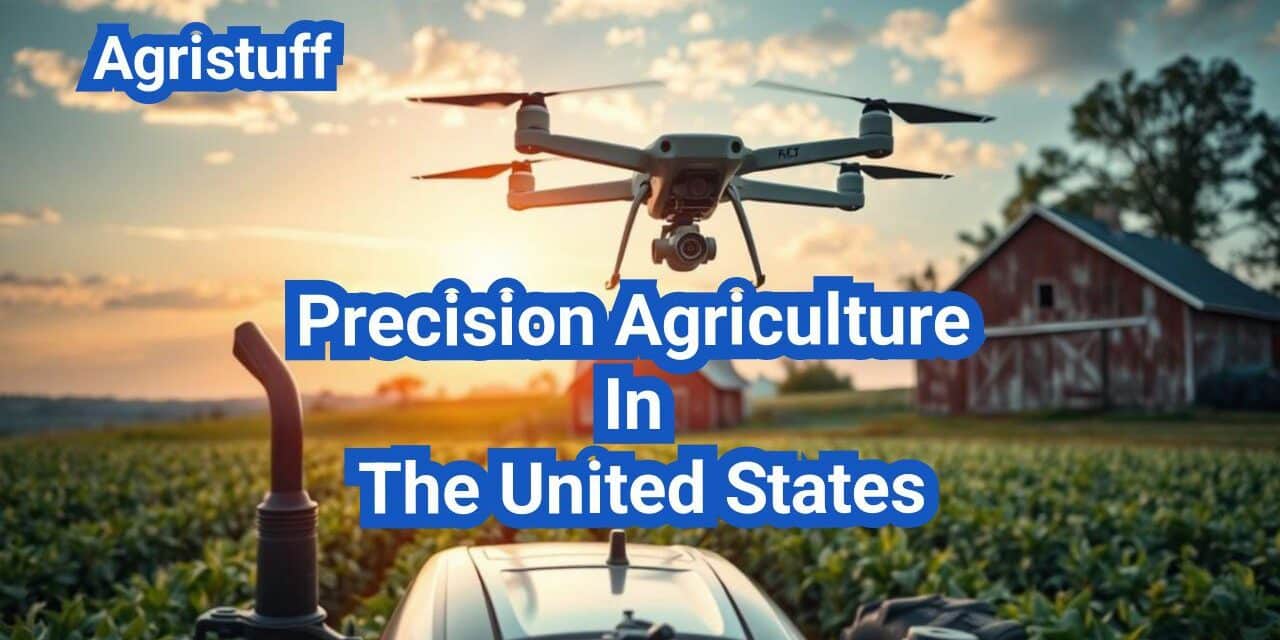
Drones complement satellite data in Precision agriculture In The United States by capturing ultra-high-resolution images on demand, underneath cloud cover, and at the exact growth stage a farmer cares about. They are widely used for stand counts, mapping damage after storms, identifying spot disease outbreaks, and creating precise weed or nutrient prescriptions. Drone scouting is especially valuable in specialty crops, where early detection has a big economic payoff. University of Minnesota Extension on farm drone use.
Farm management software ties Precision agriculture In The United States together
Precision agriculture In The United States is only as good as the decisions it supports, and that’s where farm management platforms matter. These tools store yield, soil, machine, and weather data in one place, letting farmers compare seasons, calculate input efficiency by zone, and produce compliance records. Many U.S. growers now plan operations digitally first, then export prescriptions straight into equipment displays. USDA ERS on digital agriculture adoption.
AI decision support is growing in Precision agriculture In The United States
Artificial intelligence is the newest layer in Precision agriculture In The United States. Machine-learning models can analyze multi-year yield maps, real-time sensor streams, and imagery to recommend optimal nitrogen rates, spot anomalies, or predict disease risk. While AI won’t replace farmer judgment, it does help sort huge data volumes into clear actions, which is why U.S. research agencies are investing heavily in AI-enabled agriculture. NSF on AI research priorities.
Automation and robotics reshape Precision agriculture In The United States
Automation pushes Precision agriculture In The United States from “seeing variability” to “acting on it automatically.” Camera-guided sprayers now target weeds plant-by-plant, and robotic cultivators remove weeds without herbicides in some U.S. vegetable and cotton systems. Autonomy reduces labor pressure, improves timing, and makes ultra-precise management practical even on large acreages. USDA on agricultural robotics.
Precision irrigation is a major U.S. use case
In water-stressed regions, Precision agriculture In The United States often starts with irrigation management. Soil moisture sensors, canopy temperature tools, and VRT pivots allow variable-rate irrigation, applying more water to sandy zones and less to heavier soils. This improves yield stability while lowering pumping costs and conserving groundwater, a key issue in places like the High Plains and California’s Central Valley. USGS on irrigation water use and efficiency.
Specialty crops are catching up in Precision agriculture In The United States
Precision agriculture In The United States first spread fast in corn and soybean systems, but specialty crops are now adopting tools tailored to orchards, vineyards, and vegetables. Tree-by-tree mapping, fruit load estimation, and targeted spray systems help U.S. growers handle high-value crops where uniform management wastes money. Because specialty fields are smaller but more valuable per acre, precision tools can pay back quickly. UC Agriculture & Natural Resources precision ag resources.
Precision livestock farming expands Precision agriculture In The United States
Precision agriculture In The United States is not only about crops. In livestock, wearable sensors and automated feeders track weight gain, rumination, temperature, and activity to detect health issues early and optimize nutrition. U.S. dairies increasingly use milking robots and sensor-based herd management to improve labor efficiency and animal welfare, while beef and poultry producers apply similar monitoring at scale. University of Wisconsin Extension on precision livestock.
Adoption levels across U.S. regions and farm types
Adoption of Precision agriculture In The United States varies by region, crop, and farm size. Row-crop areas with large fields and strong dealer networks tend to lead in guidance and VRT, while smaller or diversified farms adopt selectively. USDA surveys summarized by GAO show a meaningful share of U.S. farms use at least one precision technology, but full-system adoption still has room to grow, especially in underserved rural areas. GAO adoption summary using USDA survey data.
Economics and ROI of Precision agriculture In The United States
The return on Precision agriculture In The United States comes from higher yield where inputs respond, lower costs where they don’t, and reduced risk through early detection. Auto-steer alone can save fuel and inputs by cutting overlap, while VRT can reduce fertilizer or seed costs in low-yield zones. Many U.S. farms see payback within a few seasons when technologies are matched to real field variability. Oklahoma State on precision ag economics.
Environmental benefits and conservation outcomes
Precision agriculture In The United States supports conservation by applying nutrients and pesticides only where needed, reducing runoff, drift, and leaching. Zone-based liming can improve pH without over-applying, and targeted nitrogen reduces nitrous oxide emissions while protecting waterways. These outcomes align with national priorities for soil health and climate-smart agriculture across U.S. landscapes. USDA climate-smart agriculture framework.
Federal incentives and research funding for precision tools
Public investment is a strong driver of Precision agriculture In The United States. USDA, NSF, and land-grant universities fund research on sensors, AI, robotics, and interoperability, while conservation programs and cost-share initiatives help producers buy or trial eligible technologies. This blend of R&D and adoption support reflects how precision farming benefits both farm profitability and public resources. NRCS conservation programs and cost-share.
Broadband access is a hidden requirement
Precision agriculture In The United States increasingly depends on stable rural broadband because machines upload maps, software pulls imagery, and multi-farm operations coordinate digitally. Weak connectivity can limit real-time features and slow adoption in remote counties. Programs like USDA ReConnect aim to close this gap so precision tools work reliably on every U.S. farm, not just the ones near towns. USDA ReConnect rural broadband program.
Interoperability and brand “lock-in” challenges
One frustration in Precision agriculture In The United States is that equipment and software from different brands don’t always communicate smoothly. A producer may need multiple displays or subscriptions, and data transfer can be clunky. Industry standards like ISOBUS help, but U.S. farmers still push for more open systems so they can choose best-fit tools without losing data continuity. ASABE standards supporting equipment compatibility.
Farm data privacy and ownership concerns
Precision agriculture In The United States runs on data, but farmers understandably worry about who owns it, who can sell it, and how it might be used against them. Clear agreements and transparent privacy principles encourage adoption, especially when cloud platforms and AI models require data sharing. Trust is essential: without it, farms may under-use powerful decision tools. Ag Data Transparent privacy principles.
Training and extension support make precision work
Because Precision agriculture In The United States blends agronomy with technology, success depends on skills as much as hardware. Many U.S. farmers learn through local extension workshops, on-farm trials, and dealer training. The best results come when data is interpreted with solid agronomic knowledge—turning maps into practical decisions rather than pretty pictures. Land-grant Extension role in farm innovation.
A realistic starting roadmap for new adopters
If you’re starting Precision agriculture In The United States from scratch, go step-by-step: first build accurate boundaries and guidance lines, then add yield monitoring to spot zones, then test variable-rate on a single input like lime or nitrogen. Keep the first trials simple, measure results honestly, and expand only where you see consistent gains. This approach fits both large U.S. operations and smaller farms that want low-risk entry. University of Missouri guide to precision adoption.
What the future looks like for U.S. precision farming
The next wave of Precision agriculture In The United States will likely feature more autonomy, cheaper sensors, and better models that translate data into decisions automatically. Expect wider use in specialty crops and livestock, stronger carbon and ecosystem-service measurement, and more “whole-farm” connectivity. As standards improve and rural broadband expands, precision practices should become a default part of U.S. farm management. USDA ERS on precision ag trends.
Final thought
Precision agriculture In The United States is ultimately about doing the right thing in the right place at the right time—using technology to sharpen a farmer’s instincts, not replace them. When adopted thoughtfully, it can raise yields, cut costs, protect water and soil, and make U.S. farms more resilient to market and climate shocks. The farms that win with precision are the ones that treat data as a tool for learning every season. USDA on benefits of precision agriculture.
Sources & References
These authoritative resources informed this article on Precision agriculture In The United States and provide deeper technical or policy detail.
- GAO Precision Agriculture Technology Assessment
- USDA ARS: Precision agriculture overview
- USDA ARS: Benefits and evolution of precision agriculture
- USDA ERS: Precision Agriculture in the Digital Era
- UF/IFAS: Variable-rate technology
- NASA Earthdata: Remote sensing background
- University of Minnesota Extension: Drones on farms
- NRCS: Conservation programs
- USDA ReConnect: Rural broadband support
- Ag Data Transparent: Data privacy principles